




Process layout
Process Overview
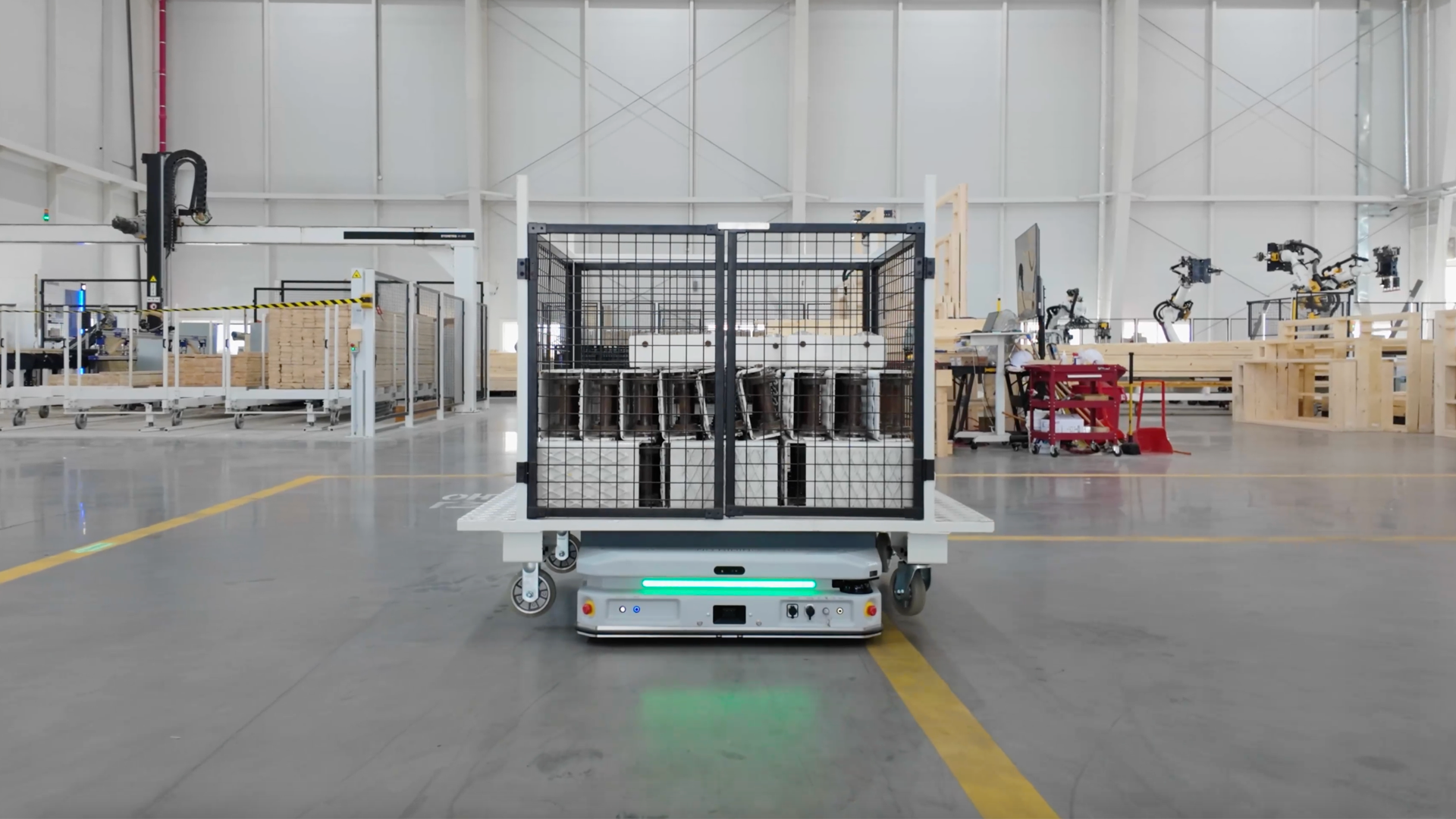
This case study demonstrates the installation of a KUKA KMP 1500P logistics robot at Bigwave Robotics (Marosol) to transport rollers and scrap debris within the space manufacturing facility. The KMP 1500P autonomously handles up to 1 ton of scrap debris over a 1.2 km distance and automatically transports heavy-duty roller modules weighing up to 1 ton. Furthermore, sensors embedded in the KMP 1500P enabled the development of an unmanned system capable of safely transporting heavy-duty materials.
Project Background and Purpose
- Automated unmanned transport using autonomous robots
- Robots perform simple, repetitive tasks
- Safe operation of heavy-duty products using various sensors
- Remote control and monitoring using SOLlink
Components
| Robot | KUKA KMP 1500P *2 |
|---|---|
| Peripherals | 2 automatic robot charging stations; 1 manual robot charging station; 1 hardware PC for KUKA robot server; 1 license for KUKA robot server; 2 SOLlink tablet controllers; 1 SOLlink server; 5 robot transport carts; 10 cart stations |
Workflow
| STEP 1. | Loading of carts in the departure area (loading area) |
|---|---|
| STEP 2. | Work command via SOLlink (tablet) |
| STEP 3. | Loading carts in the departure area using a robot lift |
| STEP 4. | Transporting carts to the destination area |
| STEP 5. | Unloading carts using a robot lift |
| STEP 6. | Setting automatic charging during non-work hours |
| STEP 7. | Charging |
| STEP 8. | Waiting for work after recovering to the preset battery level |
| STEP 9. | When robots cross, give way to the robot with priority and then cross (priority granting criteria: order of work commands) |
Features
Convenience
- Real-time robot monitoring using SOLlink
- Easy robot operation using SOLlink (tablet)
- In-factory Wi-Fi for convenient access without spatial constraints
- Automatic charging function for robot battery maintenance
- Safety using 360-degree lidar and 3D cameras
Safe robot sensor-based transportation
- Equipped with various sensors, including 3D cameras and LiDAR
- Automatic stop upon detection of obstacles or people
- Fall prevention function
Automation of simple tasks
- Improved work efficiency through automated movement
- Maximized work time by utilizing surplus time
Results
| Key Benefits | Automated material handling → Automatically handles over 80 times per day without human intervention, approximately doubling work efficiency.
Safe transport of 1-ton heavy-duty debris → Safety detection and collision avoidance are fully implemented using 3D cameras and LiDAR sensors.
Autonomous driving route optimization → Automatically drives along a set path within a 1.2km section, with priority control when robots intersect to ensure safety.
Improved worker working conditions → Eliminates repetitive heavy-duty transport tasks, reducing worker fatigue and enhancing process focus.
Improved process efficiency and stable operating rates → Automatically recharges and enables continuous unmanned transport, even during nighttime and non-working hours. |
|---|---|
| Client Feedback | Back when heavy debris had to be moved manually, there were many safety concerns and fatigue buildup.
Now, robots are doing the work for us, making it much safer. |
Unauthorized copying or reproduction of any content on Marosol may violate the Unfair Competition Prevention Act and Copyright Act.

Process layout
Process Overview
This case study demonstrates the installation of a KUKA KMP 1500P logistics robot at Bigwave Robotics (Marosol) to transport rollers and scrap debris within the space manufacturing facility. The KMP 1500P autonomously handles up to 1 ton of scrap debris over a 1.2 km distance and automatically transports heavy-duty roller modules weighing up to 1 ton. Furthermore, sensors embedded in the KMP 1500P enabled the development of an unmanned system capable of safely transporting heavy-duty materials.
Project Background and Purpose
- Automated unmanned transport using autonomous robots
- Robots perform simple, repetitive tasks
- Safe operation of heavy-duty products using various sensors
- Remote control and monitoring using SOLlink
Components
| Robot | KUKA KMP 1500P *2 |
|---|---|
| Peripherals | 2 automatic robot charging stations; 1 manual robot charging station; 1 hardware PC for KUKA robot server; 1 license for KUKA robot server; 2 SOLlink tablet controllers; 1 SOLlink server; 5 robot transport carts; 10 cart stations |
Workflow
| STEP 1. | Loading of carts in the departure area (loading area) |
|---|---|
| STEP 2. | Work command via SOLlink (tablet) |
| STEP 3. | Loading carts in the departure area using a robot lift |
| STEP 4. | Transporting carts to the destination area |
| STEP 5. | Unloading carts using a robot lift |
| STEP 6. | Setting automatic charging during non-work hours |
| STEP 7. | Charging |
| STEP 8. | Waiting for work after recovering to the preset battery level |
| STEP 9. | When robots cross, give way to the robot with priority and then cross (priority granting criteria: order of work commands) |
Features
Convenience
- Real-time robot monitoring using SOLlink
- Easy robot operation using SOLlink (tablet)
- In-factory Wi-Fi for convenient access without spatial constraints
- Automatic charging function for robot battery maintenance
- Safety using 360-degree lidar and 3D cameras
Safe robot sensor-based transportation
- Equipped with various sensors, including 3D cameras and LiDAR
- Automatic stop upon detection of obstacles or people
- Fall prevention function
Automation of simple tasks
- Improved work efficiency through automated movement
- Maximized work time by utilizing surplus time
Results
| Key Benefits | Automated material handling → Automatically handles over 80 times per day without human intervention, approximately doubling work efficiency.
Safe transport of 1-ton heavy-duty debris → Safety detection and collision avoidance are fully implemented using 3D cameras and LiDAR sensors.
Autonomous driving route optimization → Automatically drives along a set path within a 1.2km section, with priority control when robots intersect to ensure safety.
Improved worker working conditions → Eliminates repetitive heavy-duty transport tasks, reducing worker fatigue and enhancing process focus.
Improved process efficiency and stable operating rates → Automatically recharges and enables continuous unmanned transport, even during nighttime and non-working hours. |
|---|---|
| Client Feedback | Back when heavy debris had to be moved manually, there were many safety concerns and fatigue buildup.
Now, robots are doing the work for us, making it much safer. |
Unauthorized copying or reproduction of any content on Marosol may violate the Unfair Competition Prevention Act and Copyright Act.