




Process layout
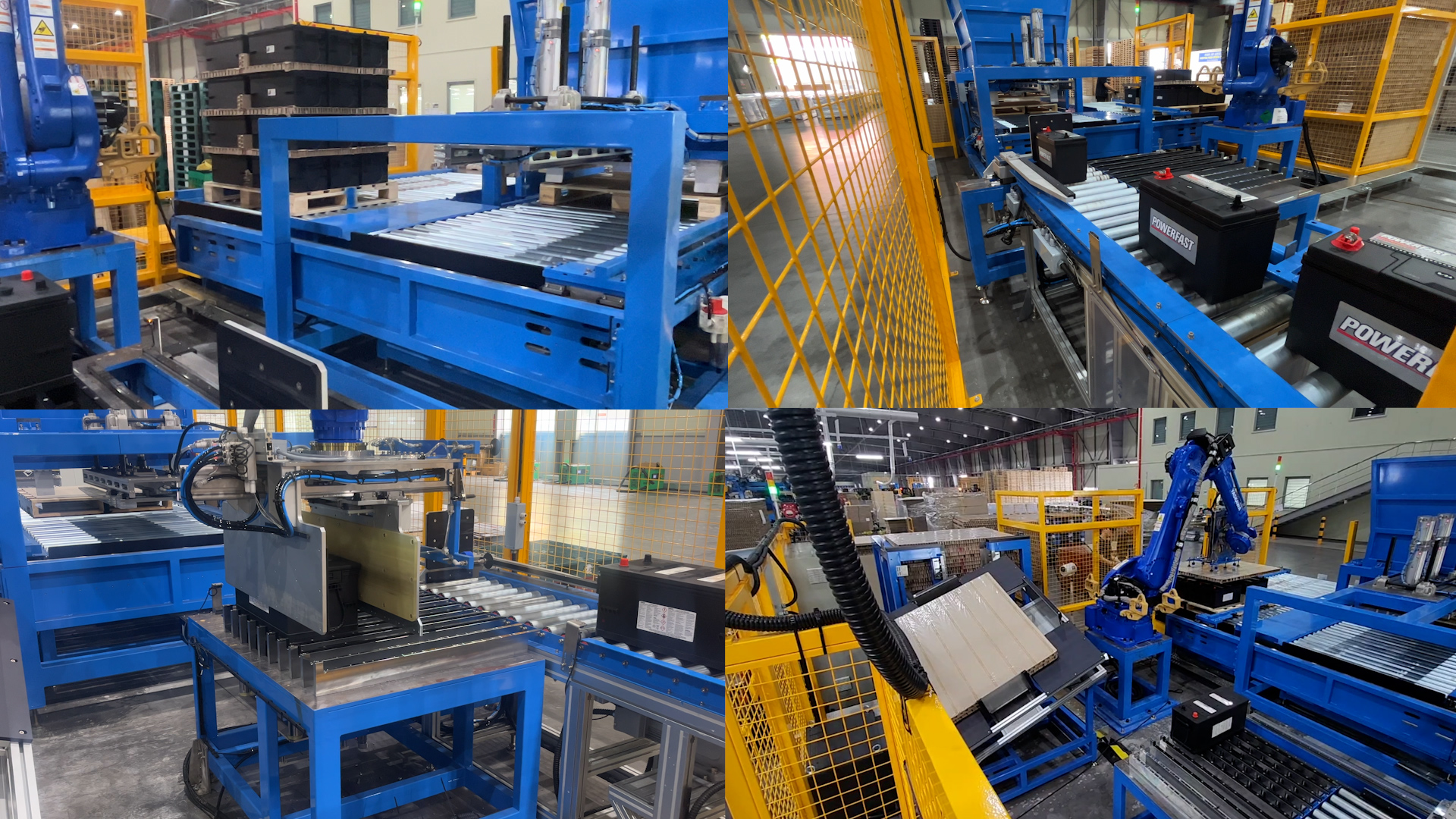
This solution automates the repalletizing process for Atlas batteries produced by Hankook & Company for export. Due to the diverse import pallet specifications, customer-specific palletizing patterns, and product types, the total number of possible scenarios exceeds 200. The goal is to standardize these scenarios and ensure line stability by supporting a throughput of 10 pallets per minute for medium-sized batteries and 6 pallets per minute for large-sized batteries.
[Pallet Feeder & Pallet Conveyor]
- This solution allows for the use of up to five different pallet types per country, ensuring a smooth 10-stack logistics cycle. Destacked pallets are transported to the battery palletizing position and aligned simultaneously. Completed pallets are transported to the discharge position.
[Battery Sorter]
- Batteries fed inline are automatically sorted into 1st, 2nd (series/parallel), and 3rd layers according to the preset palletizing pattern. The robot then discharges the batteries, repeating the initialization process.
[Robot Palletizer]
- Once aligned, the batteries are picked and placed at the palletizing position on the conveyor, repeating the pick-and-place process according to the specified location and number of layers. Honeycomb feeds are automatically inserted into each layer according to the settings.
[Honeycomb Feeder & Sorter]
- Automatically sorts and inserts honeycombs into each layer of NO-BOX batteries.
Components
| Robot | YASKAWA GP225 |
|---|
Workflow
| STEP 1. | Pallet Feeder & Pallet Conveyor |
|---|---|
| STEP 2. | Battery Sorter |
| STEP 3. | Robot Palletizer |
| STEP 4. | Honeycomb Feeder & Sorter |
Features
- Standardized palletizing for various pallets, patterns, and products.
- Secured daily palletizing capacity of 2,000 large and 4,000 medium-sized pallets, based on a 10-hour daily operation and an 85% safety margin.
- Reduced the number of workers per line from 4 to 1.
- Operator training, manuals, BOM lists, and spare parts lists were created and distributed. Video materials were secured for manager reference. Emergency response was provided in the event of a line shutdown.
Results
| Client Feedback | Palletizing batteries weighing up to 60 kg by hand by four people was a highly shunned task due to the risk of musculoskeletal disorders and even fatalities in the event of a fall. Even with four people working, the logistics cycle was not smooth, resulting in significant labor costs. However, after automating palletizing with Marosol, we were able to reduce the number of workers per line from four to one, ensuring safer work. |
|---|
Unauthorized copying or reproduction of any content on Marosol may violate the Unfair Competition Prevention Act and Copyright Act.
Recommended Solution

A House Built by Robots?! Space Factory Automates Modular Housing Window Assembly! 🛠️🏠
Project Overview This case marks Korea's first automated solution for modular housing window assembly, combining a KUKA industrial robot, a custom-designed robotic gripper, and a High Payload Track Motion system. Space Factory introduced this automation system to reduce construction costs and ensure consistent quality in modular housing production. Background & Objective Traditionally, skilled workers manually assembled window frames on-site, which was time-consuming and labor-intensive. Meeting diverse client requirements also demanded a large workforce. In addition, the wide and complex work environment made real-time monitoring and process control difficult. The goal of this project was to automate the window assembly process to significantly reduce work time, establish a standardized production system for consistent quality, and enhance process management through real-time production monitoring.

Burr removal finished with deburring robot automation! Can it really be this easy? 😮
A robotic deburring system utilizing two robots to automatically remove burrs generated on the machined surface after knuckle processing for Honda Accord vehicles. It achieves perfect deburring of complex-shaped product surfaces through the collaboration of a positioning robot and a deburring robot, as well as the configuration of a dedicated deburring device for areas where the deburring tool has access. By integrating with the processing line, it implements automation for deburring, cleaning, Inspection , rust prevention, and packaging, resulting in a fully automated complete process.

Yuhan-Kimberly's Choice! Fully Automated Depalletizing and String Cutting 📦
Process Overview This implementation case, implemented at Yuhan-Kimberly's Chungju factory , combines a Yaskawa industrial robot with a string cutting workstation to achieve automated depalletizing and string cutting. The client introduced the depalletizing system to reduce labor costs and work fatigue, and expressed strong interest in automating rope cutting and discharge to maximize cost savings and efficiency. This solution sorts and cuts boxes of various sizes before feeding them to the case packer, improving the efficiency of the box feeding and rope cutting processes, while also reducing the physical burden on workers and ensuring safety. Project Background and Objectives At Yuhan-Kimberly's Chungju factory , the process of dismantling palletized boxes and loading them into case packers individually was entirely manual. This process was highly repetitive and presented a constant risk of safety accidents due to the use of knives during the removal of the twine. The goal of this project was to automate the entire process, from depalletizing to loading into the case packer, minimizing human dependence. Furthermore, by unmanning the twine cutting process, we aimed to ensure worker safety, reduce fatigue and on-site personnel burden, and ensure stable plant operations.
Process layout
This solution automates the repalletizing process for Atlas batteries produced by Hankook & Company for export. Due to the diverse import pallet specifications, customer-specific palletizing patterns, and product types, the total number of possible scenarios exceeds 200. The goal is to standardize these scenarios and ensure line stability by supporting a throughput of 10 pallets per minute for medium-sized batteries and 6 pallets per minute for large-sized batteries.
[Pallet Feeder & Pallet Conveyor]
- This solution allows for the use of up to five different pallet types per country, ensuring a smooth 10-stack logistics cycle. Destacked pallets are transported to the battery palletizing position and aligned simultaneously. Completed pallets are transported to the discharge position.
[Battery Sorter]
- Batteries fed inline are automatically sorted into 1st, 2nd (series/parallel), and 3rd layers according to the preset palletizing pattern. The robot then discharges the batteries, repeating the initialization process.
[Robot Palletizer]
- Once aligned, the batteries are picked and placed at the palletizing position on the conveyor, repeating the pick-and-place process according to the specified location and number of layers. Honeycomb feeds are automatically inserted into each layer according to the settings.
[Honeycomb Feeder & Sorter]
- Automatically sorts and inserts honeycombs into each layer of NO-BOX batteries.
Components
| Robot | YASKAWA GP225 |
|---|
Workflow
| STEP 1. | Pallet Feeder & Pallet Conveyor |
|---|---|
| STEP 2. | Battery Sorter |
| STEP 3. | Robot Palletizer |
| STEP 4. | Honeycomb Feeder & Sorter |
Features
- Standardized palletizing for various pallets, patterns, and products.
- Secured daily palletizing capacity of 2,000 large and 4,000 medium-sized pallets, based on a 10-hour daily operation and an 85% safety margin.
- Reduced the number of workers per line from 4 to 1.
- Operator training, manuals, BOM lists, and spare parts lists were created and distributed. Video materials were secured for manager reference. Emergency response was provided in the event of a line shutdown.
Results
| Client Feedback | Palletizing batteries weighing up to 60 kg by hand by four people was a highly shunned task due to the risk of musculoskeletal disorders and even fatalities in the event of a fall. Even with four people working, the logistics cycle was not smooth, resulting in significant labor costs. However, after automating palletizing with Marosol, we were able to reduce the number of workers per line from four to one, ensuring safer work. |
|---|
Unauthorized copying or reproduction of any content on Marosol may violate the Unfair Competition Prevention Act and Copyright Act.
Recommended Solution
A House Built by Robots?! Space Factory Automates Modular Housing Window Assembly! 🛠️🏠
Project Overview This case marks Korea's first automated solution for modular housing window assembly, combining a KUKA industrial robot, a custom-designed robotic gripper, and a High Payload Track Motion system. Space Factory introduced this automation system to reduce construction costs and ensure consistent quality in modular housing production. Background & Objective Traditionally, skilled workers manually assembled window frames on-site, which was time-consuming and labor-intensive. Meeting diverse client requirements also demanded a large workforce. In addition, the wide and complex work environment made real-time monitoring and process control difficult. The goal of this project was to automate the window assembly process to significantly reduce work time, establish a standardized production system for consistent quality, and enhance process management through real-time production monitoring.
Burr removal finished with deburring robot automation! Can it really be this easy? 😮
A robotic deburring system utilizing two robots to automatically remove burrs generated on the machined surface after knuckle processing for Honda Accord vehicles. It achieves perfect deburring of complex-shaped product surfaces through the collaboration of a positioning robot and a deburring robot, as well as the configuration of a dedicated deburring device for areas where the deburring tool has access. By integrating with the processing line, it implements automation for deburring, cleaning, Inspection , rust prevention, and packaging, resulting in a fully automated complete process.
Yuhan-Kimberly's Choice! Fully Automated Depalletizing and String Cutting 📦
Process Overview This implementation case, implemented at Yuhan-Kimberly's Chungju factory , combines a Yaskawa industrial robot with a string cutting workstation to achieve automated depalletizing and string cutting. The client introduced the depalletizing system to reduce labor costs and work fatigue, and expressed strong interest in automating rope cutting and discharge to maximize cost savings and efficiency. This solution sorts and cuts boxes of various sizes before feeding them to the case packer, improving the efficiency of the box feeding and rope cutting processes, while also reducing the physical burden on workers and ensuring safety. Project Background and Objectives At Yuhan-Kimberly's Chungju factory , the process of dismantling palletized boxes and loading them into case packers individually was entirely manual. This process was highly repetitive and presented a constant risk of safety accidents due to the use of knives during the removal of the twine. The goal of this project was to automate the entire process, from depalletizing to loading into the case packer, minimizing human dependence. Furthermore, by unmanning the twine cutting process, we aimed to ensure worker safety, reduce fatigue and on-site personnel burden, and ensure stable plant operations.